


Summary
A panic attack can feel overwhelming, but it is usually a temporary surge of the body’s alarm system.

The most helpful approach is to check for medical danger, name the panic, slow the breath, ground in the present, stop scanning symptoms, relax the body, use steady self-talk and let the wave pass.

If panic attacks keep happening, professional support can make a major difference.
Panic attacks can feel frightening, but they will pass
A panic attack is a sudden wave of intense fear or discomfort that can make the body feel out of control. It may cause a racing heart, chest tightness, shortness of breath, dizziness, shaking, sweating, nausea, tingling, hot flushes or a strong fear that something terrible is about to happen. For many people, the most frightening part is not knowing whether it is panic or a medical emergency.
Panic attacks are common and treatable. They are not a sign of weakness, and they do not mean a person is “going crazy”. They happen when the body’s threat system switches on too strongly, even when there is no immediate danger. This can create a loop where physical sensations feel scary, the fear increases and the symptoms become stronger.
The aim during a panic attack is not always to stop it instantly. A more realistic goal is to reduce the fear response, steady the body and remind the brain that the wave will pass. The following strategies can help many people move through a panic attack more safely and with less fear.
First, check that it is safe to treat it as panic
Panic attacks can feel similar to serious medical problems, especially heart, breathing or neurological symptoms. Call triple zero (000) for an ambulance if chest pain is severe, new or spreading to the arm, jaw, back or shoulder, or if there is fainting, severe breathlessness, confusion, weakness on one side of the body, blue lips, collapse or symptoms that feel different from a usual panic attack.
A person should also seek medical advice if they have never had a panic attack before, if attacks keep happening, if symptoms are changing or if they are avoiding normal activities because of fear of another attack. A GP can help rule out physical causes such as heart problems, asthma, thyroid disease, diabetes, medication effects, substance use or inner ear problems.
Name what is happening
The first step is to identify the attack without judging it. Try saying:
“This is a panic attack. It feels awful, but it will pass”
Naming the experience can reduce the extra fear that comes from thinking something catastrophic is happening.
This works because panic often grows when symptoms are misread as danger. A racing heart may be interpreted as a heart attack. Dizziness may be interpreted as fainting. Shortness of breath may be interpreted as suffocation. Labelling the experience as panic helps interrupt that fear cycle.
A simple phrase can help:
“I am having a panic attack. My body is in alarm mode. I do not need to fight it”
Slow the breath without forcing it
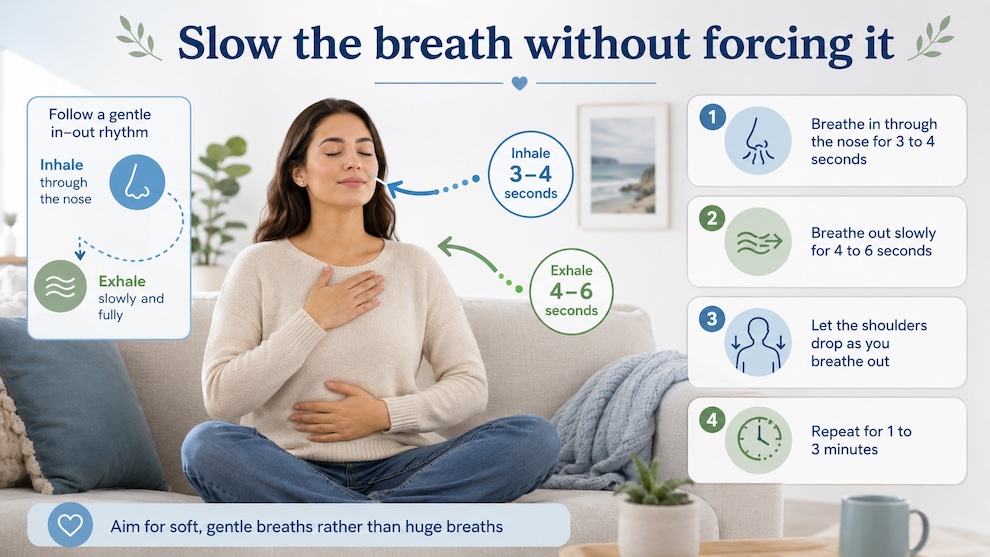
During a panic attack, breathing may become fast, shallow or irregular. This can worsen dizziness, tingling, chest tightness and feelings of unreality. The aim is not to take huge breaths, as this can make symptoms worse. The aim is to breathe slowly and gently.
Try this:
Breathe in through the nose for 3 to 4 seconds.
Breathe out slowly for 4 to 6 seconds.
Let the shoulders drop as you breathe out.
Repeat for 1 to 3 minutes.
If counting makes the panic worse, use a simpler cue:
“soft breath in, long breath out”
The out-breath is especially useful because it helps signal to the nervous system that the body can move out of high-alert mode.
Ground yourself with the 5-4-3-2-1 technique
Grounding brings attention back to the present moment. This is useful because panic often pulls attention inward, making every heartbeat, breath and body sensation feel threatening.
Try naming:
5 things you can see
4 things you can feel
3 things you can hear
2 things you can smell
1 thing you can taste
This technique gives the brain a structured task and reminds it that the current environment is safer than the panic response suggests. It can be done silently, out loud or with another person guiding you.
Stop checking every symptom
It is natural to scan the body during a panic attack, but constant checking can keep the alarm system switched on. Repeatedly checking the pulse, testing the breath, searching symptoms online or asking “am I okay?” over and over can briefly reassure the mind, then restart the fear cycle.
Instead, try shifting from monitoring to allowing:
“I notice my heart is racing, and I am going to let it race while I breathe slowly.”
“I notice dizziness, and I am going to sit safely and let it pass.”
“I do not need to solve every sensation right now.”
This does not mean ignoring medical warning signs. It means that once emergency symptoms have been ruled out or the attack is familiar, symptom-checking is usually less helpful than grounding, breathing and reassurance.
Relax one part of the body at a time
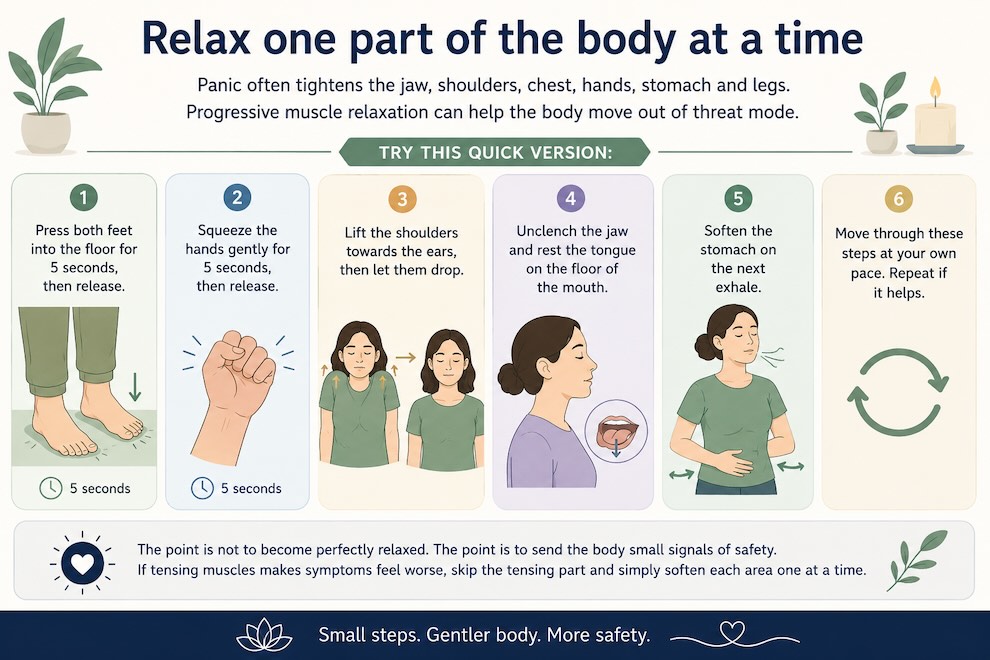
Panic often tightens the jaw, shoulders, chest, hands, stomach and legs. Progressive muscle relaxation can help the body move out of threat mode.
Try this quick version:
Press both feet into the floor for 5 seconds, then release.
Squeeze the hands gently for 5 seconds, then release.
Lift the shoulders towards the ears, then let them drop.
Unclench the jaw and rest the tongue on the floor of the mouth.
Soften the stomach on the next exhale.
The point is not to become perfectly relaxed. The point is to send the body small signals of safety. If tensing muscles makes symptoms feel worse, skip the tensing part and simply soften each area one at a time.
Use a steady coping statement
Panic attacks often come with frightening thoughts such as “I cannot cope”, “I am going to die”, “I will lose control” or “I need to escape right now”. A coping statement gives the mind something steadier to hold onto.
Helpful examples include:
“This is uncomfortable, not dangerous.”
“This is a wave. It will rise, peak and fall.”
“I have felt this before and it passed.”
“I can let my body do this without fighting it.”
“I do not have to feel calm to be safe.”
Repeat one phrase slowly while breathing out. It may not remove the panic straight away, but it can stop the fear from escalating.
Change your focus with a simple task
Once the first intense wave starts to settle, a small task can help the brain move out of panic mode. Choose something simple, familiar and non-demanding.
You could:
Count backwards from 100 by threes.
Name all the blue objects in the room.
Fold a towel slowly.
Sip water.
Step outside and describe what you can see.
Walk slowly around the room.
Listen to a familiar song.
The task should be calming rather than frantic. The aim is to redirect attention, not to run away from the panic. Avoid rushing, pacing aggressively or doing anything unsafe, especially if you feel dizzy.
Let the attack finish instead of fighting it
One of the hardest but most useful skills is learning not to fight the panic attack. Telling yourself “stop panicking” can sometimes increase pressure and make the symptoms feel more dangerous. Panic usually settles more easily when the person stops wrestling with it and lets the body complete the alarm response.
Try thinking of the attack as a false alarm:
“My body is trying to protect me, but there is no immediate danger.”
“The alarm is loud, but it is not an emergency.”
“I can ride this out.”
When the panic begins to ease, do not immediately analyse everything that happened. Give the body time to recover. Drink water, sit quietly, stretch gently or return slowly to what you were doing.
What to do after a panic attack
After a panic attack, people often feel tired, shaky, embarrassed or worried about the next one. This is common. It can help to write down what happened in a neutral way:
Where was I?
What was I thinking before it started?
What body sensations did I notice first?
What helped even a little?
Did I avoid anything afterwards?
This can reveal patterns without turning the attack into something to fear. It can also be useful to discuss with a GP or psychologist.
How to reduce future panic attacks
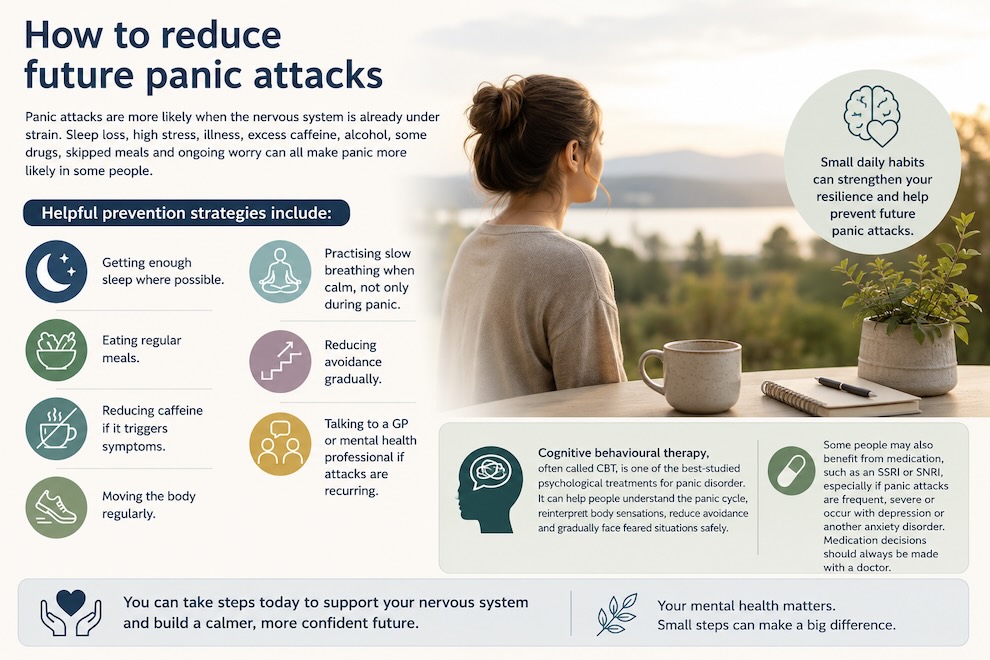
Panic attacks are more likely when the nervous system is already under strain. Sleep loss, high stress, illness, excess caffeine, alcohol, some drugs, skipped meals and ongoing worry can all make panic more likely in some people.
Helpful prevention strategies include:
Getting enough sleep where possible.
Eating regular meals.
Reducing caffeine if it triggers symptoms.
Moving the body regularly.
Practising slow breathing when calm, not only during panic.
Reducing avoidance gradually.
Talking to a GP or mental health professional if attacks are recurring.
Cognitive behavioural therapy, often called CBT, is one of the best-studied psychological treatments for panic disorder. It can help people understand the panic cycle, reinterpret body sensations, reduce avoidance and gradually face feared situations safely. Some people may also benefit from medication, such as an SSRI or SNRI, especially if panic attacks are frequent, severe or occur with depression or another anxiety disorder. Medication decisions should always be made with a doctor.
When to see a doctor
See a GP or health professional if panic attacks happen more than once, come without a clear trigger, cause ongoing worry, affect sleep or stop you from driving, working, exercising, socialising or leaving home.
Seek urgent help if panic symptoms come with thoughts of self-harm, feeling unsafe, severe depression, substance misuse or fear that you might hurt yourself or someone else.
In Australia, call triple zero (000) if there is immediate danger.
Lifeline is available on 13 11 14, text 0477 13 11 14 or online chat if someone is overwhelmed, in crisis or needs immediate emotional support.
References
Andrews G, Bell C, Boyce P, Gale C, Lampe L, Marwat O et al. Royal Australian and New Zealand College of Psychiatrists clinical practice guidelines for the treatment of panic disorder, social anxiety disorder and generalised anxiety disorder. Australian & New Zealand Journal of Psychiatry. 2018;52(12):1109-1172. doi: 10.1177/0004867418799453
Banushi B, Brendle M, Ragnhildstveit A, Murphy T, Moore C, Egberts J et al. Breathwork interventions for adults with clinically diagnosed anxiety disorders: a scoping review. Brain Sciences. 2023;13(2):256. doi: 10.3390/brainsci13020256
Beyond Blue. Panic disorder and panic attacks. Beyond Blue. Accessed 17 June 2026.
Centre for Clinical Interventions. When panic attacks. Government of Western Australia, Department of Health. Updated 2026.
Healthdirect Australia. Panic attacks and panic disorder. Healthdirect Australia. Accessed 17 June 2026.
Kaczkurkin AN, Foa EB. Cognitive-behavioral therapy for anxiety disorders: an update on the empirical evidence. Dialogues in Clinical Neuroscience. 2015;17(3):337-346. doi: 10.31887/DCNS.2015.17.3/akaczkurkin
Lampe L. Drug treatment for anxiety. Australian Prescriber. 2013;36(6):186-189. doi: 10.18773/austprescr.2013.076
Muhammad Khir S, Wan Mohd Yunus WMA, Mahmud N, Wang R, Panatik SA, Mohd Sukor MS et al. Efficacy of progressive muscle relaxation in adults for stress, anxiety and depression: a systematic review. Psychology Research and Behavior Management. 2024;17:345-365. doi: 10.2147/PRBM.S437277
National Institute for Health and Care Excellence. Generalised anxiety disorder and panic disorder in adults: management. Clinical guideline CG113. Updated 7 May 2024.
Pompoli A, Furukawa TA, Imai H, Tajika A, Efthimiou O, Salanti G. Psychological therapies for panic disorder with or without agoraphobia in adults: a network meta-analysis. Cochrane Database of Systematic Reviews. 2016;4(4). doi: 10.1002/14651858.CD011004.pub2
Last reviewed and updated: 17 June 2026
