


Probiotics
Probiotics are live microorganisms that can provide a health benefit when consumed in adequate amounts. They include certain bacteria and yeasts found in some foods, drinks and dietary supplements.
Probiotics are often called “good” or “friendly” bacteria. However, not every live microorganism is a probiotic. To be considered a probiotic, the microorganism must be identified, remain alive in sufficient numbers and have evidence showing a health benefit.
What are probiotics?
The digestive system contains trillions of microorganisms collectively known as the gut microbiome. These microorganisms include bacteria, viruses, fungi and other microbes.
Many gut microorganisms support normal digestion, help produce certain substances needed by the body and interact with the immune system. Probiotics may temporarily add beneficial microorganisms to this community or influence how existing gut microorganisms function.
Probiotics do not usually remain in the gut permanently. Their effects often depend on taking the correct strain in an appropriate amount for a particular purpose.
Important probiotic facts
- Probiotics are live microorganisms with a demonstrated health benefit
- Different probiotic strains can have different effects
- A probiotic that helps one condition may not help another
- A higher number of microorganisms does not automatically make a product more effective
- Probiotic effects are usually specific to the genus, species and strain tested
- Some probiotics may help prevent antibiotic-associated diarrhoea
- Some strains may ease certain digestive symptoms, although results vary
- Probiotics are generally well tolerated by healthy people
- People who are seriously ill or immunocompromised should seek medical advice before using probiotic supplements
- Probiotics should not replace medical treatment or delay an assessment of ongoing symptoms
How probiotics work
Probiotics may support health through several mechanisms.
Supporting the gut barrier
The intestinal lining forms a barrier between the contents of the digestive tract and the rest of the body. Some probiotics may help maintain this barrier and support the cells that line the intestine.
Competing with harmful microorganisms
Probiotic microorganisms may compete with potentially harmful microbes for nutrients and attachment sites within the gut. Some also produce substances that make the environment less suitable for certain unwanted microorganisms.
Supporting digestion
Certain probiotic strains help break down food components. Some may help digest lactose, which is the natural sugar in dairy products.
Influencing immune activity
The gut microbiome communicates with the immune system. Some probiotics may influence immune responses, although the effects depend on the strain, dose and person taking them.
Producing useful substances
Some probiotics produce substances such as organic acids. These substances can influence the environment within the gut and the activity of other microorganisms.
Types of probiotics
Probiotic names may include a genus, species and strain.
For example:
Lacticaseibacillus rhamnosus GG
- Lacticaseibacillus is the genus
- rhamnosus is the species
- GG identifies the strain
The strain is important because two strains from the same species may not provide the same health effects.
Common groups used in probiotic foods and supplements include:
- Bifidobacterium
- Lactobacillus and related reclassified genera
- Saccharomyces
- Streptococcus
- Bacillus
Saccharomyces boulardii is a probiotic yeast. Most other commonly used probiotics are bacteria.
Food sources of probiotics
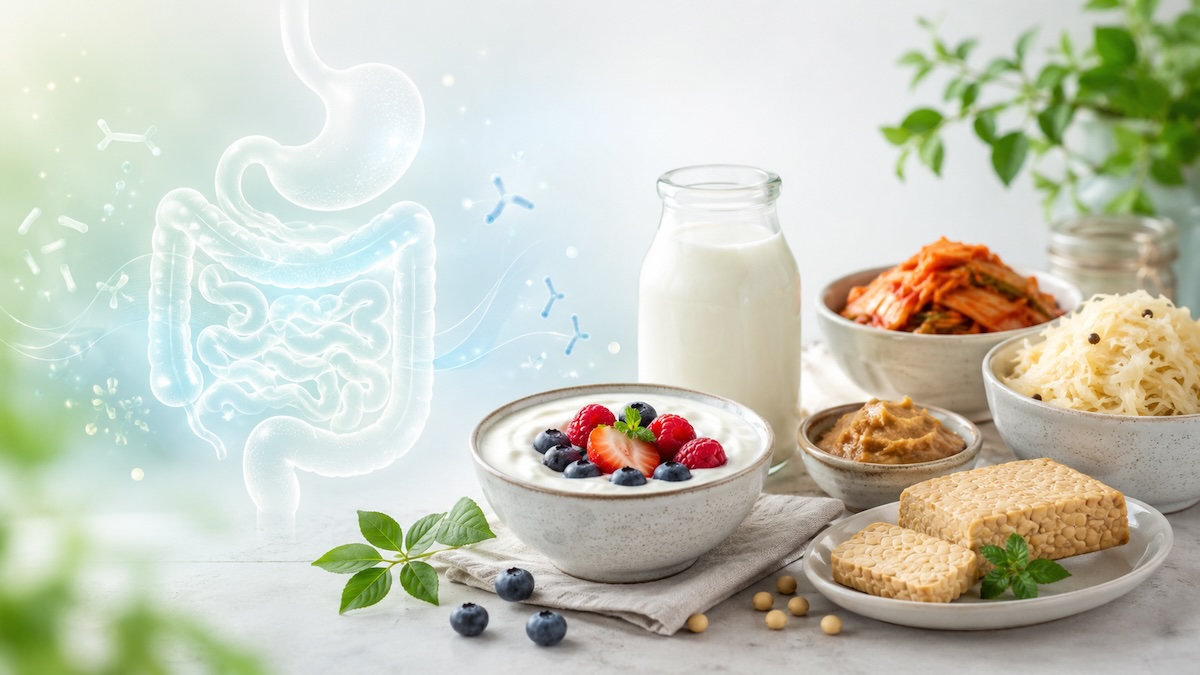
Foods that may contain live microorganisms include:
- yoghurt containing live cultures
- kefir
- some fermented milk drinks
- fresh sauerkraut
- kimchi
- miso
- tempeh
- some traditionally fermented pickles
- kombucha
Not every fermented food is a probiotic food. Heating, pasteurisation, filtering and long storage can reduce or destroy live microorganisms. Some fermented foods contain live microbes but have not been studied closely enough to show a specific probiotic benefit.
Check the packaging for terms such as “live cultures” or “active cultures”. The label may also identify the microorganisms used.
Probiotics and prebiotics
Probiotics are live microorganisms, while prebiotics are substances that are used by beneficial gut microorganisms and provide a health benefit.
Prebiotics are commonly found in fibre-rich foods such as:
- legumes
- onions
- garlic
- oats
- barley
- bananas
- asparagus
- artichokes
- nuts and seeds
Products containing both probiotics and prebiotics are known as synbiotics.
Eating a varied diet containing vegetables, fruit, legumes, wholegrains, nuts and seeds helps provide the fibres needed to support a diverse gut microbiome.
Potential health benefits
The effects of probiotics depend on the particular strain or combination of strains used. Research does not support treating all probiotic products as interchangeable.
Antibiotic-associated diarrhoea
Some probiotics may reduce the likelihood of diarrhoea associated with antibiotic treatment. The benefit depends on the strain, dose, timing and individual risk factors.
A doctor or pharmacist can advise whether a probiotic is suitable. Probiotics should not be used as a substitute for prescribed antibiotics.
Irritable bowel syndrome
Certain probiotics may improve overall irritable bowel syndrome symptoms, abdominal discomfort, bloating or wind in some people. However, studies have produced mixed results and it is not yet clear which probiotic is best for every person with IBS.
Infectious diarrhoea
Some probiotic strains have been studied for acute infectious diarrhoea. The possible benefit varies according to age, cause of the diarrhoea and strain used.
Persistent or severe diarrhoea requires medical advice, particularly when it occurs in babies, older adults or people at risk of dehydration.
Constipation
Some probiotics may modestly improve bowel movement frequency or stool consistency in certain people. Evidence is not consistent across all strains or age groups.
Lactose digestion
Live cultures used in some yoghurts may help people digest lactose more effectively. Individual tolerance still varies.
Other possible uses
Probiotics are being studied for immune health, vaginal health, allergies, oral health and several metabolic conditions. Evidence for many of these uses remains limited, inconsistent or specific to particular strains.
Probiotics should not be promoted as a treatment for all digestive, immune or inflammatory conditions.
Probiotic supplements
Probiotic supplements are available as capsules, powders, liquids, chewable products and sachets.
The number of live microorganisms is often listed in colony-forming units, abbreviated as CFU. A larger CFU number does not necessarily mean that the product is more effective. The dose should be supported by research involving the same strain and intended use.
When choosing a probiotic supplement, check for:
- the full genus, species and strain name
- the number of live microorganisms provided
- whether the stated amount applies at manufacture or through to expiry
- the expiry date
- storage instructions
- the recommended dose
- the intended health use
- allergen information
- an AUST L or AUST L(A) number when the product is supplied as a probiotic medicine in Australia
Follow the storage directions carefully. Some probiotics require refrigeration, while others are designed to remain stable at room temperature. Heat, moisture and unsuitable storage can reduce the number of living microorganisms.
Side effects and safety
Healthy people generally tolerate probiotics well. Temporary side effects can include:
- bloating
- increased wind
- abdominal discomfort
- changes in bowel movements
- diarrhoea
These symptoms may settle as the digestive system adjusts. Stop using the product and speak with a healthcare professional if symptoms are severe, persistent or worsening.
Although uncommon, probiotic microorganisms can cause serious infections in vulnerable people. Medical advice is particularly important for people who:
- have a weakened immune system
- are receiving chemotherapy
- take immunosuppressive medicine
- have recently undergone major surgery
- are critically ill
- have a central venous catheter
- have serious intestinal disease
- have a significant heart valve disorder
- have been admitted to hospital with a severe illness
Premature babies and seriously ill infants should only receive probiotics under the direction of their specialist healthcare team. Serious and potentially fatal infections associated with probiotic organisms have been reported in premature infants.
Parents should speak with a doctor, paediatrician or dietitian before giving a probiotic supplement to a baby or child.
When to see a doctor
Speak with your doctor, pharmacist or Accredited Practising Dietitian before taking a probiotic if you have a medical condition, take regular medicines or are unsure which strain is appropriate.
Seek medical advice if you experience:
- ongoing or severe abdominal pain
- persistent diarrhoea
- blood or mucus in the stool
- unexplained weight loss
- recurrent vomiting
- fever
- signs of dehydration
- difficulty swallowing
- symptoms that repeatedly return
- digestive symptoms that wake you during the night
Probiotics should not be used to delay medical care or replace prescribed treatment.
References
- Healthdirect Australia. Probiotics. Australian Government-supported health information service. Accessed 27 July 2026.
- Hill C, Guarner F, Reid G, Gibson GR, Merenstein DJ, Pot B, Morelli L, Canani RB, Flint HJ, Salminen S, Calder PC, Sanders ME. Expert consensus document: The International Scientific Association for Probiotics and Prebiotics consensus statement on the scope and appropriate use of the term probiotic. Nature Reviews Gastroenterology & Hepatology. 2014;11(8):506–514.
- International Scientific Association for Probiotics and Prebiotics. Probiotics. Accessed 27 July 2026.
- National Center for Complementary and Integrative Health. Probiotics: usefulness and safety. National Institutes of Health, USA. Accessed 27 July 2026.
- Therapeutic Goods Administration. Demonstrating the quality of listed probiotic medicines. Australian Government Department of Health, Disability and Ageing. Updated 25 February 2025. Accessed 27 July 2026.
Last reviewed and updated: 27 March 2026

