


Facts
Measles is a very contagious disease, which used to be very rare because the MMR immunisation program is in place in most countries.
Measles is caused by the rubeola virus.
Measles can infect up to 90% of anyone who isn’t immune and who comes close to an infected person.
In 2019, Australia had 284 registered measles cases, which was concerning. But in 2021, there were 0 cases. In 2022, there were 7 cases. In 2023, there were 26 cases. These are the cases that are reported to medical authorities. There still could be more which are not reported.
Incubation period
Incubation period
The incubation period is the length of time it takes from being infected by someone else with measles, to showing symptoms. It will take 1-2 weeks before you show any symptoms.
Measles has an incubation period of: 7-14 days
If you catch measles, you are infectious 4 days before the rash starts, to 4 days after.
Catching measles
How do you get measles?
You can catch measles in a few ways:
- breathing in tiny infected droplets from infected people, when they cough or sneeze
- going into a room where a person with measles just left
The risk of catching measles is higher if your immune system is somewhat impaired (people with serious underlying conditions, older people) or not evolved (babies and children).
Symptoms
Symptoms of measles
- Fever – a high fever which may go up over 40°C (104°F)
- Cold-like symptoms – chills, sore throat, runny nose, red watery eyes (conjunctivitis) generally feeling unwell
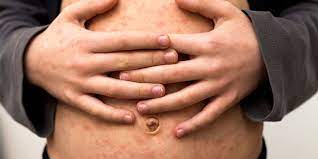
- Rash – brownish-pink spots start 3-4 days after the first cold-like symptoms. They spread from behind the ears, down the face, neck, trunk and limbs over 3 days
- Small white spots inside the mouth – these can occur about 1-2 days before the skin rash starts
- Swollen glands – the lymph glands may be visibly swollen
- Sensitivity to light – this is an uncommon symptom, but can occur in some babies and toddlers
Treatment
Treatment of measles
- See a doctor – any child with suspected measles needs to see a doctor who can perform an examination to diagnose this condition
- Rest – the child should rest to help the body heal itself
- Fluids – plenty of fluids (water, natural juice)
- Lotion – the doctor will prescribe a lotion for relieving any itching of the rash spots (calamine lotion, paste of bicarbonate of soda mixed with water, watered down lavender oil)
- Cool bath – a cool bath with oatmeal and bicarbonate of soda added may help to reduce itchiness
- Bath with lavender or chamomile – a few drops of either lavender or chamomile oil to the bath water may help the baby or toddler sleep better, as both of these oils have calming properties
- Medication – the doctor may advise giving the baby paracetamol or ibuprofen to reduce the fever
Complications
Complications
Complications can occur with measles and usually occurs in 1 in 15 children
The people most at risk of measles complications are:
- children with chronic illness
- children under 5 years
- pregnant women
- people with impaired immune systems
The most common complications of measles are middle ear infection, diarrhoea, pneumonia, bronchitis or convulsions.
- Ear infections occur in about 1 in every 10 cases of measles
- Diarrhoea occurs in less 1 in every 10 cases of measles
Pneumonia is a serious complication. Pneumonia is an infection that affects one or both lungs. It causes the air sacs in the lungs to fill up with fluid or pus. Pneumonia can be deadly.
Encephalitis, is another serious complication. Encephalitis is a serious inflammation of the brain cells. It occurs in 1 in every 1,000 cases of measles. Encephalitis can be deadly.
Around 1-3 in every 1,000 children will die from complications related to the respiratory or neurological systems.
Vaccination
Vaccination
All children under 14 should receive of the varicella vaccine.
The national immunisation schedule advises children to be immunised with the:
- MMRV vaccine for measles, mumps, rubella and varicella at 18 months. This is free
- second dose of the MMRV vaccine at least 4 weeks after the first dose. This is not free
Risk
Reducing risk of infection
The best and easiest way to prevent infection is to get vaccinated. Children should receive two doses of the MMRV vaccine to ensure they and their community are safe from measles infection.
Other strategies to reduce infection:
- if your child gets measles, keep them away from school and other children
- discuss the measles infection with your doctor
- ensure you and your child/children wash hands with a sanitising hand soap
- wash toys and clothes in detergent that has a sanitising effect
- wipe down surfaces with a 70% alcohol solution
- pregnant women should stay away from anyone who has measles
References
References
- Measles. Department of Health and Aged Care. Accessed 9 July 2024
- Measles. World Health Organisation. Accessed 9 July 2024
- Measles (rubeola). CDC USA. Accessed 9 July 2024
- Measles vaccine. National immunisation schedule. Accessed 9 July 2024
Last reviewed and updated: 9 July 2024

