Facts
Why vitamin B1 (thiamin) is good for you
Vitamin B1 (thiamine) is involved in the production of glucose (or energy) for the brain and nervous system, to ensure they are working effectively. Without enough energy to the brain and nervous system, a person can become forgetful, depressed, tired and apathetic.
Vitamin B1 (thiamine) also helps to keep the heart beating strongly and healthily, because it keeps the heart muscle elastic.
Important vitamin B1 (thiamin) facts
- Alcohol and the tannins found in teas destroy vitamin B1 (thiamin), so drink these after finishing a meal.
- Vitamin B1 (thiamin) absorption is helped by the other B Vitamins and magnesium.
- Since vitamin B1 (thiamin) is involved in the production of glucose, one symptom of vitamin B1 (thiamin) deficiency is inability to use glucose normally – important for diabetes and hypoglycaemia.
- Being low on vitamin B1 (thiamin) gives a predisposition to getting canker sores, painful, crater-like sores in the mouth
Vitamin B1 (thiamin) works best with
Health
Vitamin B1 (thiamin) and health
- Protecting the heart – vitamin B1 (thiamin) helps the heart beat strongly and regularly and ensures the heart muscle is elastic and works well. A person low on vitamin B1 (thiamin), may have heart muscle that may not be elastic enough and could lead to abnormal heartbeat
- Diabetes – even though vitamin B1 (thiamin) is involved in glucose (or energy) production, it has not been proved to help those with diabetes
- Canker Sores – people low on vitamin B1 (thiamin) are more likely to get frequent canker sores in their mouth
Talk to a medical professional about vitamin B1 (thiamin) supplements before taking them.
Deficiency
Groups at risk of vitamin B1(thiamin) deficiency
- The elderly – may need more vitamin B1 (thiamin) due to malabsorption and/or poor diet
- Pregnant or breastfeeding mothers – much of the nutrients eaten are passed onto the child and extra may be needed each day to top up supplies of vitamin B1 (thiamin).
- People who diet frequently – less than 1,500 calories a day may not include enough vitamin B1 (thiamin) in the foods eaten
- People who fast – may not be getting enough vitamin B1 (thiamin)
- Diabetics – too much vitamin B1 (thiamin) has been shown to be excreted in the urine of diabetic patients by recent research
- Chronic or acute infections/illnesses – any illness that causes fever makes the body work faster, therefore uses up more of its nutrients
- Alcoholics – tend to eat poorly, so vitamin intake is low. In addition, alcohol blocks absorption of many nutrients, as well as excreting much that is absorbed
Talk to a medical professional about vitamin B1 (thiamin) supplements before taking them.
Symptoms of vitamin B1 (thiamin) deficiency
Vitamin B1 (thiamin) deficiency is very rare as it is so easily found in the typical diet of most people, that very few people are seriously deficient, but deficiency still occurs in the less developed countries.
Severe vitamin B1 (thiamin) deficiency after only ten days without adequate intake through the diet (or supplements) causes the disease Beri Beri.
Beri beri is identified with the following deficiency symptoms:
- muscles weakness
- loss of appetite
- poor coordination
- severe pain in the calves
- tingling in the nerves
Sometimes Beriberi causes the heart to enlarge, which is very serious and can be life-threatening.
Vitamin B1 (thiamin) deficiency, caused by alcoholism, eventually causes a type of nerve damage called Wernicke-Korsakoff syndrome.
Food sources
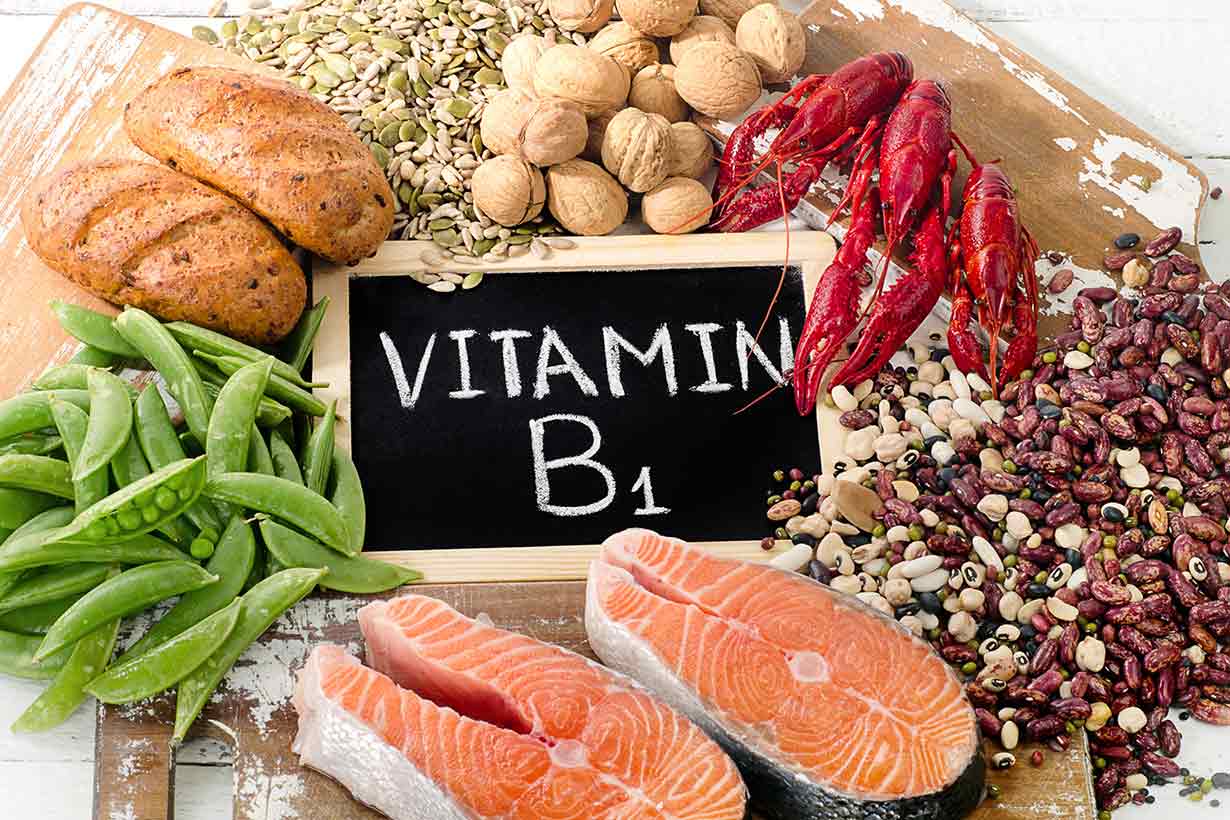
Vitamin B1 (thiamin) in food
| FOOD | AMOUNT | Vitamin B1 (mg) |
|---|---|---|
Sunflower seeds | 85g | 1.95 |
Ham | 85g | 0.82 |
Wheatgerm | ¼ cup | 0.55 |
Pork, roasted | 85g | 0.52 |
Peanuts | 85g | 0.36 |
Pecans | 85g | 0.27 |
Oatmeal | 1 cup | 0.26 |
Beef, liver | 85g | 0.23 |
Potato | 1 medium | 0.22 |
Bagel | 1 medium | 0.21 |
Beans, black | ½ cup | 0.21 |
Peas, green | ½ cup | 0.21 |
Raisins | ½ cup | 0.21 |
Rice, brown | 1 cup | 0.20 |
Cashews | 85g | 0.18 |
Corn | ½ cup | 0.18 |
Beans, kidney | ½ cup | 0.14 |
Orange | 1 medium | 0.13 |
Asparagus, steamed | 1 cup | 0.12 |
Bread, whole wheat | 1 slice | 0.09 |
Milk, non-fat | 1 cup | 0.09 |
Chicken, roasted | 85g | 0.06 |
Beef, lean | 85g | 0.05 |
Daily intake
Vitamin B1 (thiamin) recommended daily intake (RDI)
| RDA | lifestage | age | Amount |
|---|---|---|---|
| INFANTS | 0-6mths 7-12mths | 0.2mg 0.3mg | |
| CHILDREN | 1-3yrs 4-8yrs | 0.5mg 0.6mg | |
| CHILDREN | 9-13yrs male: 14-18yrs female: 14-18yrs | 0.9mg 1.2mg 1.0mg | |
| ADULTS | male: 19-50yrs female: 19-50yrs | 1.2mg 1.1mg | |
| SENIORS | male: 51+yrs female: 51+yrs | 1.2mg 1.1mg | |
| PREGNANT | 1.4mg | ||
| LACTATING | 1.4mg | ||
| TOLERABLE UPPER LIMIT | none established | ||
| TOXIC LEVELS | >125mg/kg body weight | ||
The tolerable upper limits should only be taken for short periods and only under medical supervision.
Toxicity
Overdosage, toxicity and cautions for vitamin B1 (thiamin)
Vitamin B1 (thiamin) is a relative non-toxic vitamin, except at exceedingly high doses.
Side effects at the high doses (listed above) are:
- fast heart beat (tachycardia)
- hot flushes
- nervousness
- fluid retention
- shortness of breath
- sweating
- tremors
Precautions
Precautions
Side effects of toxicity have also been noted at levels at 100 times higher than the recommended dietary allowances (ie at only 100mg doses) in some people.
Interactions
References
References
- Abbas ZG, Swai AB. Evaluation of the efficacy of thiamine and pyridoxine in the treatment of symptomatic diabetic peripheral neuropathy. East Afr Med J 1997;74(12):803-808
- Ambrose, ML, Bowden SC, Whelan G. Thiamin treatment and working memory function of alcohol-dependent people: preliminary findings. Alcohol Clin Exp Res. 2001;25(1):112-116
- Duran M, Wadman SK. Thiamine-responsive inborn errors of metabolism. J Inherit Metab Dis 1985;8 Suppl 1:70-75
- Food and Nutrition Board, Institute of Medicine. Pantothenic acid. Dietary Reference Intakes: Thiamin, Riboflavin, Niacin, Vitamin B-6, Vitamin B-12, Pantothenic Acid, Biotin, and Choline. Washington, D.C.: National Academy Press; 1998:357-373
- Office of Dietary Supplements USA – has the official USA RDI for all vitamins (these are also adopted by Australia), accessed 9 August 2005
- Osiecki, Henry, The Nutrient Bible 2002, BioConcepts Publishing
- Ranganathan LN, Ramaratnam S. Vitamins for epilepsy. Cochrane Database Syst Rev 2005;(2):CD004304
- Rodriquez-Martin JL, Qizilbash N, Lopez-Arrieta JM. Thiamine for Alzheimer’s disease (Cochrane Review). Cochrane Database Syst Rev. 2001;2:CD001498
Last reviewed and updated: 9 May 2024